

The buyer is ultimately responsible for verifying repairs after a home inspection, but that does not mean you do it alone. A combination of your real estate agent, the original inspector, and licensed contractors each play a role in confirming that the seller followed through.
At Serenity Home Inspections, we offer a dedicated repair verification inspection for buyers who want an independent, professional confirmation before they close.
Who Is Responsible for Verifying Repairs?
Short answer: the buyer.
You have the most at stake, and once you close, any repair issues become your problem, regardless of what was agreed to in the contract. The seller is not going to call you after closing to fix something they missed.
That said, the practical responsibility is shared. Your agent keeps the process moving, the inspector can return to verify work, and contractors leave a paper trail. What ties it all together is you pushing to confirm everything before the closing date arrives.
The Four Parties Involved in Repair Verification
Repair verification is rarely one person’s job. Here’s how each party fits into the process.
The Buyer
As the buyer, your job is to stay organized. Keep a copy of the original inspection report alongside the repair addendum: the document listing which items the seller agreed to fix. Before closing, compare each line item against the receipts or documentation the seller provides.
During your final walkthrough, test the items that were repaired. Turn on the HVAC. Run the faucets. Check the outlets the inspector flagged. If something was supposed to be replaced and it looks untouched, that is the time to raise the issue. Not after you sign.
The Real Estate Agent
Your agent is your advocate through this process. They handle the back-and-forth with the seller’s agent, request documentation, and push back if something looks incomplete. A good agent will prompt you to schedule a re-inspection rather than rely on the seller’s word alone.
Agents do not do technical evaluations themselves. They cannot tell you whether an electrical repair was done to code or whether a roof patch was done correctly. That is the inspector’s job.
The Original Inspector
The most reliable way to verify that repairs were completed properly is to have a licensed inspector return to the property. This is called a repair verification inspection or re-inspection.
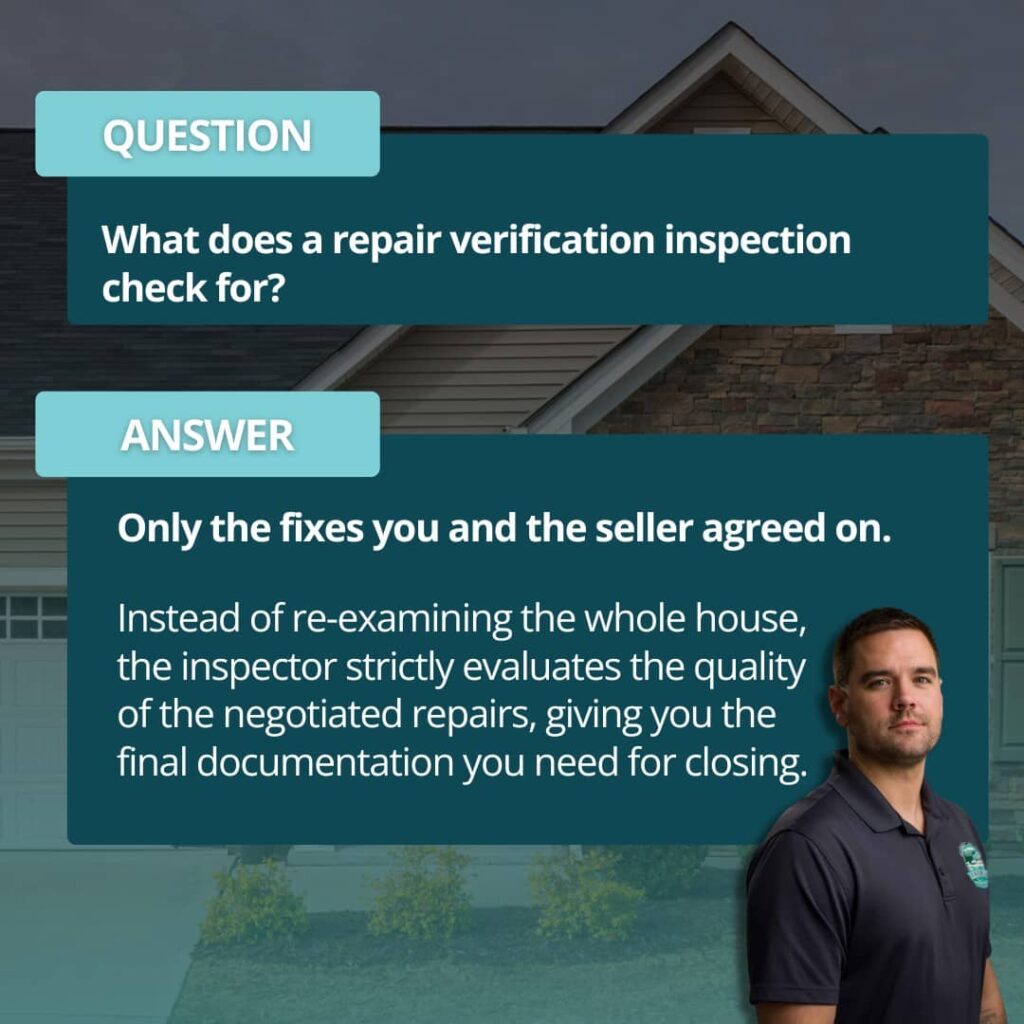
The inspector reviews only the items listed in the original report’s repair agreement. It is not a full second inspection of the home.
Serenity offers repair verification inspections as a stand-alone service. We confirm that each agreed repair was completed and done to an acceptable standard, then deliver a written report you can bring to closing with confidence.
Licensed Contractors
When the seller hires a contractor to make repairs, that contractor should provide documentation: receipts, work orders, and, in some cases, permits. For significant repairs (roof replacement, HVAC work, electrical panel upgrades), a licensed contractor should have pulled a permit, and you can verify that with your local building department.
Receipts alone are not a guarantee of quality. A contractor can invoice for work and still do it incorrectly. This is exactly why an independent inspector verification is a better safeguard than paperwork alone.
What Does a Repair Verification Inspection Cover?
A repair verification inspection is more focused than a full re-inspection. Here is exactly what that scope includes, and where it stops.
Here’s What Gets Checked
A repair verification inspection is scoped to the items in the original repair agreement. The inspector will:
- Confirm each negotiated repair was completed
- Verify the quality of the work, which can be assessed visually
- Note any items that appear incomplete or improperly repaired
- Deliver a written report documenting findings
This service is faster and less expensive than a full re-inspection because the scope is limited. It is not a hunt for new problems. It is confirmation that the agreed-upon items were handled.
Here’s What’s Not Included
A repair verification inspection does not cover new issues that were not in the original report, systems that are not readily accessible, or work that requires a permit pull or engineering assessment to verify.
If the seller made repairs in areas that require a specialist (foundation, structural, HVAC, refrigerant), you may need a separate specialist sign-off in addition to the inspector’s verification.
Per InterNACHI’s Standards of Practice, home inspectors report on visual, accessible conditions. Verification inspections follow the same scope.
What to Do If Repairs Were Not Done Correctly
Not ideal, but you have options before the closing date passes.
Ask for Documentation First
Before escalating, request the contractor receipts and permits. Some repairs that look incomplete actually have documentation showing they were done inside the wall or in a way that is not visually obvious.
Give the seller a chance to provide proof before assuming the worst.
Request a Price Reduction or Credit
If documentation is missing or the repair verification inspection flags incomplete work, you have options before closing. Work with your agent to request a price reduction, a credit at closing, or a requirement that the seller remedy the issue before the closing date.
A credit is often preferable because it puts repair control in your hands. You choose the contractor, and you verify the work yourself after the fact. For buyers looking at older Atlanta homes where deferred maintenance is common, this is frequently the cleaner path.
Our post on what’s included in your home inspection covers how material defects are documented in the original report, which forms the basis for any credit negotiation.
Walk Away if Necessary
If significant repairs were not made and the seller will not negotiate, your inspection contingency may still protect you. Review your contract with your agent and attorney before the contingency deadline passes.
Walking away from a closing is disruptive, but closing on a home with unverified repairs is worse.
Related Questions to Explore
Can the Same Inspector Do the Re-Inspection? Yes, and it is usually preferred. The original inspector already knows the property, understands the context behind each flagged item, and can make direct comparisons between the original condition and the current state.
Serenity’s inspectors are available for repair verification on any property we originally inspected, and we also accept re-inspection requests from buyers who used a different inspector initially.
How Much Does a Repair Verification Inspection Cost? Repair verification inspections cost less than a full home inspection because the scope is limited. Pricing varies based on the number of items being verified and the size of the property. Contact Serenity directly via our packages page for current pricing or to request a quote.
What Documentation Should a Seller Provide for Repairs? At a minimum, sellers should provide itemized invoices from licensed contractors, along with permit numbers for any work that required a permit. For appliance replacements, model documentation and warranty registration records are helpful.
For roof work or HVAC replacements, manufacturer warranty paperwork transfers value to the buyer and should be requested at closing.
When to Call a Professional
If you are under contract and the seller has completed repairs, do not rely on a walkthrough alone to confirm the work. A closing walkthrough is not a technical inspection: it is a visual sweep. You are looking for obvious issues, not evaluating whether an electrical repair was done to code or whether a roof patch will hold through the next storm season.
Situations where a repair verification inspection is especially worth the cost:
- The original inspection flagged multiple items, and the seller agreed to fix all of them
- The seller is a flipper or investor rather than an owner-occupant
- Any structural, roofing, or electrical repairs were negotiated
- The seller provided receipts, but no permits for work that required them
- You simply want documentation in hand at closing
Serenity Home Inspections serves buyers throughout greater Atlanta, including Peachtree Corners, Alpharetta, Marietta, Roswell, and surrounding counties.
Our repair verification service delivers a written report the same day, so you are never waiting on paperwork as the closing date approaches. Get in contact with our team to get started.
Conclusion
Verifying repairs after a home inspection is the buyer’s responsibility, but you have tools and professionals to help you do it right. Here is what to remember:
- The buyer, agent, inspector, and contractor each play a role in repair verification
- A repair verification inspection is the most reliable way to confirm that work was done correctly
- Receipts and permits matter, but they are not a substitute for an independent inspection
- If repairs fall short, you still have options before closing
For independent, same-day repair verification in the Atlanta area, book your service visit online today.