
Common enough that four metro Atlanta counties carry the EPA’s highest risk designation, and rare enough in South Georgia that most homes there test low. Radon in Georgia follows the geology, and the geology changes as you move north.
Serenity Home Inspections tests homes across metro Atlanta, including all four of the counties the EPA flags as highest risk, and the results still surprise people on both ends. Here’s how common it actually is where you live, how a test works, and what the number means when you get it.
How Common Is Radon in Georgia?
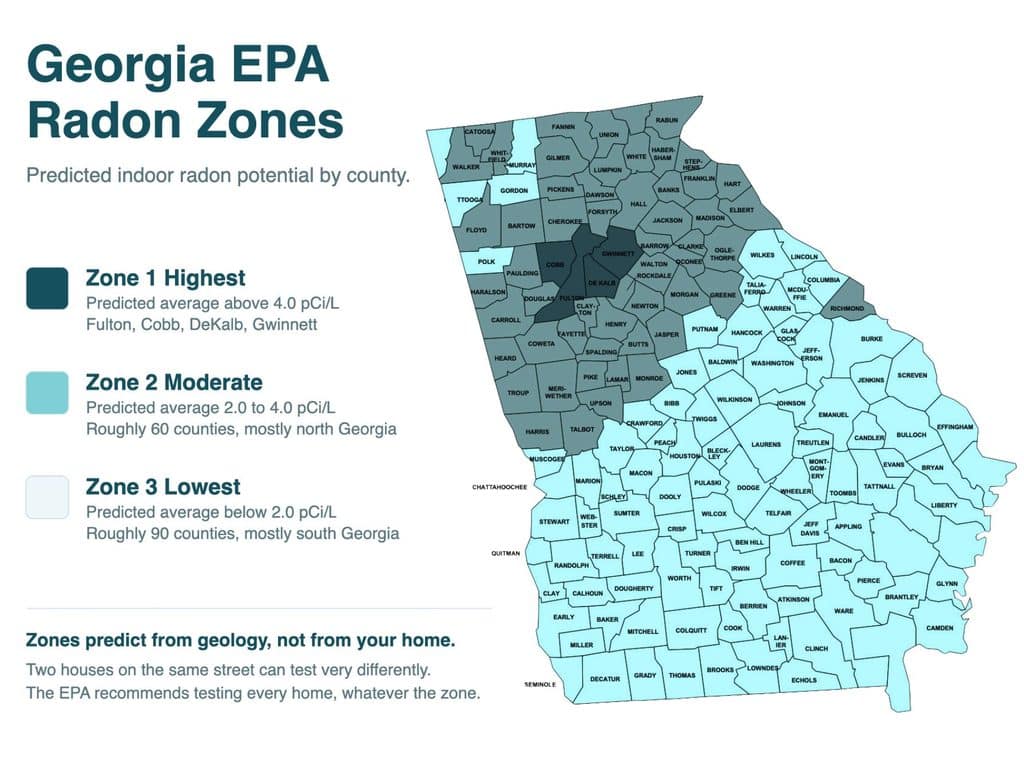
The EPA sorts every county in the country into one of three radon zones based on predicted indoor levels.
| Zone | Predicted average | Georgia counties |
|---|---|---|
| Zone 1, highest | Above 4.0 pCi/L | 4 counties: Fulton, Cobb, DeKalb, Gwinnett |
| Zone 2, moderate | 2.0 to 4.0 pCi/L | Roughly 55 counties, concentrated in north Georgia |
| Zone 3, lowest | Below 2.0 pCi/L | Roughly 100 counties, mostly south Georgia |
If you live in Fulton, Cobb, DeKalb, or Gwinnett, the EPA predicts the average home in your county tests above the action level. That is a prediction about the county, not a measurement of your house.
Zone 2 covers most of the rest of North Georgia, including Cherokee, Forsyth, and Hall. South of roughly the Macon line, most counties fall in Zone 3, where the typical home tests low.
For a closer read on your own county, the University of Georgia Radon Education Program publishes a map showing what share of homes actually tested in each county came back at 4.0 pCi/L or higher. That is measured data rather than prediction, which makes it the better place to start.
Why the North Georgia Line Matters
Radon comes from uranium decaying in soil and rock. North Georgia sits on Piedmont and Blue Ridge bedrock, granite-heavy and uranium-bearing. South of the Fall Line, the Coastal Plain runs sedimentary, with far less source material underfoot.
That geologic boundary cuts roughly through Columbus, Macon, and Augusta, and it explains the north-to-south pattern better than any county line does.
Two caveats matter more than the map itself.
- The zone maps predict; they do not measure. EPA built them from geology, aerial radiometric data, and soil characteristics so agencies could target resources.
- The maps aren’t intended to describe the levels for your specific neighborhood or house.
- Neighboring homes test differently. Two houses on the same street, same soil, same year built, can come back at 1.8 and 6.4 pCi/L. Foundation type, how the builder poured the slab, where the utility penetrations sit, and how tightly the house seals all change the result.
- A Zone 3 address is not automatically a clean bill of health, and a Zone 1 address is not automatically an urgent diagnosis.
The only way to know your home’s number is to have it tested.
How Does Radon Testing Work?
Labs report radon in picocuries per liter of air, written as pCi/L. Three approaches cover nearly every situation.
Short-Term Tests
A device sits in the lowest livable level of the home for two to seven days, then goes to a lab. Nearly every real estate transaction uses this method, because it fits inside a due diligence window.
Short-term tests require closed-house conditions. Windows and exterior doors stay shut except for normal entry and exit, starting 12 hours before the test and continuing throughout. Open a window during the test, and the result no longer counts. More tests fail for this reason than any other.
Long-Term Tests
A detector stays in place 90 days or more. Radon levels swing with season, weather, and how you run the house, so a long-term test gives a truer picture of what you actually breathe year-round. Choose this one for a home you already own and are not under contract on.
Continuous Radon Monitors
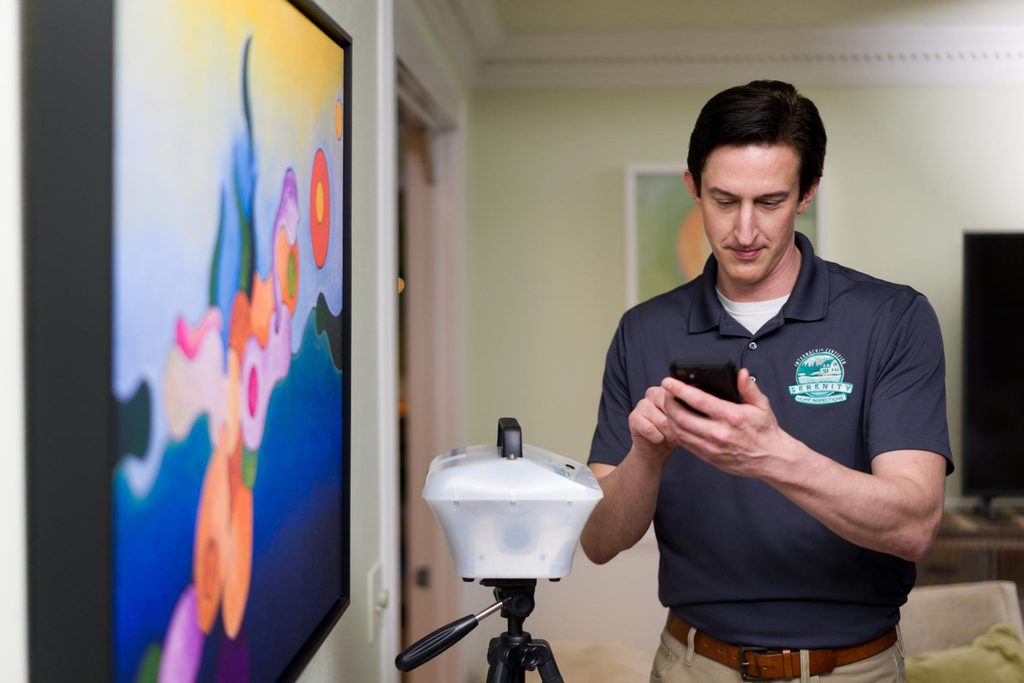
An electronic instrument samples continuously and records hourly readings. Because it timestamps everything, it reveals whether someone opened a window mid-test. That makes it the preferred tool when a buyer and seller will negotiate over the result.
You can add our radon testing to a home inspection, which is how most buyers handle it.
What Your Results Mean
The EPA’s action level is 4.0 pCi/L. At or above that number, fix it.
Below that, the guidance gets less binary than people expect. EPA also suggests considering mitigation between 2.0 and 4.0 pCi/L. The average indoor level across the United States sits around 1.3 pCi/L, and outdoor air runs lower still. No threshold makes radon harmless. There is only a point where action clearly makes sense.
So a 3.1 pCi/L result is not a pass. Treat it as a number worth thinking about, especially if children live in the house, if anyone smokes, or if someone uses a finished basement daily.
Is Radon Testing Required in Georgia?
No; and that answer matters for anyone buying or selling.
Georgia has no law requiring radon testing in a real estate transaction or in new construction.
No radon-specific disclosure statute exists either. What does apply is the general duty to disclose known material defects. A seller holding a test result that shows elevated radon has a known condition to disclose. A seller who never tested has nothing.
Practically, the buyer has to ask. Testing is almost always a buyer-ordered, buyer-paid addition to the inspection, and you need to request it inside the due diligence period for the result to help you negotiate.
One more thing worth knowing. Georgia does not license or certify radon measurement professionals, and it does not license home inspectors either. Anyone claiming a Georgia radon license is describing something that does not exist. National certification through NRPP and NRSB does exist, as do credentialing organizations like InterNACHI.
What Happens If Your Level Is High?
A result at or above 4.0 pCi/L is a fixable problem, not a reason to walk away from a house.
The standard fix is sub-slab depressurization. A contractor runs a pipe from beneath the slab up through the roofline, with an inline fan that pulls soil gas out before it reaches the living space. Crawl space homes get a sub-membrane version, where the contractor seals a vapor barrier over the ground and vents it the same way. Both approaches are mature and well understood, and both run quietly and continuously.
Georgia’s Attorney General’s consumer office puts typical mitigation cost in the range of $1,800 to $2,500. Treat that as a benchmark rather than a quote, since the number moves with foundation type, home size, and how the ductwork runs.
Retest once the system is in. A working system will bring the number down substantially, and the retest confirms it instead of leaving you to assume.
Related Questions to Explore
Should I Test if the Home Already Has a Mitigation System?
Definitely, systems fail, fans stop, and previous owners do not always retest after installation. Confirm it works rather than trusting that someone installed it correctly.
Does Radon Come Through Well Water?
It can, particularly in parts of North Georgia where groundwater moves through granite. Showering or running a tap releases radon from the water into the air. That requires a separate test from the air test, and it is worth asking about if you draw from a private well.
Is Radon Included in a Standard Home Inspection?
No. Radon testing is a separate service with separate equipment and lab work. Our post on what’s included in your home inspection covers what the base inspection does and does not cover.
Can a New Home Have High Radon?
Absolutely, and sometimes new homes test higher than old ones because they seal tighter. Some builders install passive radon-resistant systems during construction, which is worth confirming during a new construction inspection rather than assuming.
When to Call a Professional
Order a radon test when you go under contract on a home in metro Atlanta, especially in Fulton, Cobb, DeKalb, or Gwinnett. A home you have never tested deserves one too, and so does a basement you are about to finish into living space or a house whose existing mitigation system you want verified.
For a confirmed radon test result at or above 4.0 pCi/L, go to a certified radon mitigation contractor.
Testing and mitigation are different jobs, and keeping them separate means the person measuring has no stake in whether you buy a system.
Conclusion
Georgia has four EPA Zone 1 counties, all in metro Atlanta: Fulton, Cobb, DeKalb, and Gwinnett. Most of South Georgia falls in Zone 3.
- Zone maps predict based on geology, not on your house. Homes on the same street test differently, so the map tells you where to pay attention, not what you have.
- Georgia requires no radon testing and has no radon disclosure law, so a buyer has to ask for it inside the due diligence window.
Buying in metro Atlanta or wondering what your own home would read? Schedule with Serenity and add radon testing to your inspection.